Planning a Uganda safari involves many exciting decisions. Travelers think about gorilla trekking, chimpanzee tracking, game drives, boat safaris, waterfalls, wildlife photography, cultural experiences, and scenic road journeys. However, one decision can influence the comfort of almost every day of the trip: choosing the right accommodation. For travelers who want comfort without paying premium luxury prices, midrange accommodation in Uganda is often the perfect choice.
Midrange safari accommodation sits between simple budget lodging and high-end luxury properties. It provides comfortable rooms, private bathrooms, good meals, welcoming service, attractive surroundings, and convenient access to Uganda’s major tourism destinations. Guests can sleep comfortably after a long game drive, enjoy a hot shower after gorilla trekking, relax with a drink overlooking beautiful scenery, and wake up close to the activities planned for the next day.
For many travelers, this level of accommodation offers the best balance between price and experience. Instead of spending most of the safari budget on an expensive room, guests can invest in wildlife activities, gorilla permits, chimpanzee tracking, private transport, longer itineraries, and additional destinations. At the same time, they avoid sacrificing the basic comforts that make a safari relaxing.
Uganda has developed an impressive network of midrange safari lodges, tented camps, guesthouses, forest lodges, lakeside properties, and comfortable hotels. These accommodations are found around Murchison Falls National Park, Kibale National Park, Queen Elizabeth National Park, Bwindi Impenetrable National Park, Mgahinga Gorilla National Park, Lake Mburo National Park, Kidepo Valley National Park, Jinja, Entebbe, Fort Portal, Lake Bunyonyi, and many other tourism areas.
At Lena Tours, we often recommend midrange accommodation to travelers who want a comfortable Uganda safari while keeping the overall cost reasonable. The right lodge does much more than provide a bed. Location, food quality, room comfort, hospitality, scenery, and distance from safari activities can influence the entire experience.
This detailed guide explains what midrange accommodation means in Uganda, what travelers can expect, where to stay around the country’s major safari destinations, how midrange properties compare with budget and luxury lodges, and why they work so well on a complete Uganda safari.

Midrange accommodation generally describes properties that provide noticeably more comfort than basic budget lodging without reaching the premium pricing and exclusivity of luxury safari lodges.
The exact standard varies according to location.
A midrange lodge near a remote national park may look different from a midrange hotel in Entebbe or Kampala. Safari properties often focus on location, views, spacious rooms, good meals, and an authentic connection with the surrounding environment. City hotels may place greater emphasis on modern rooms, swimming pools, Wi-Fi, conference facilities, and convenient access to airports or business areas.
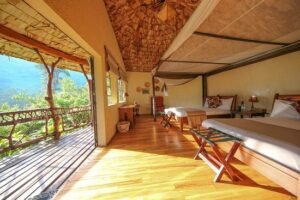
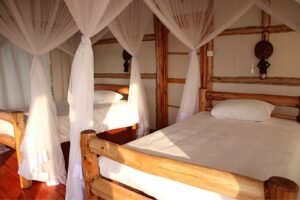
On safari, a typical midrange property may include an en-suite bathroom, comfortable beds, mosquito protection where required, electricity or solar power, hot water, a restaurant, bar or lounge, outdoor sitting areas, and attractive natural surroundings.
Some lodges have swimming pools.
Others offer views of forests, rivers, lakes, valleys, savannah, or mountains.
The style may include permanent cottages, canvas safari tents, bandas, cabins, chalets, or traditional-inspired buildings.
What matters most is not whether the accommodation looks extremely luxurious. The main goal is to provide reliable comfort in a location that supports the safari itinerary.
Travelers often discover that accommodation can consume a large part of a safari budget.
Luxury properties may be beautiful, but paying premium rates every night can significantly increase the price of a ten-day or fourteen-day trip.
Choosing midrange lodging makes it easier to keep important wildlife experiences within the itinerary.
A traveler might prefer to spend money on gorilla trekking rather than an extremely expensive room.
Another guest may want to include chimpanzee tracking, a Nile boat cruise, several national parks, and a private safari vehicle.
Using midrange lodges helps balance these priorities.
Comfort remains important because Uganda safari itineraries can involve early mornings, long road transfers, forest trekking, game drives, and busy activity schedules.
After such days, a clean room, good meal, comfortable bed, and hot shower become extremely valuable.
Midrange accommodation provides these essentials without turning every overnight stay into the most expensive component of the holiday.

One common misunderstanding is that anything below luxury must be basic.
That is not necessarily true.
Many midrange safari lodges in Uganda provide excellent hospitality and beautiful locations.
Some have views that compete directly with more expensive properties.
A lodge may overlook the Nile, sit beside tropical forest, face rolling hills near Bwindi, or provide panoramic views across Queen Elizabeth National Park.
The difference between midrange and luxury often relates to room size, exclusivity, interior finishing, personalized services, spa facilities, premium dining, private plunge pools, or other additional comforts.
Wildlife experiences remain the same.
An elephant does not behave differently because one visitor sleeps in a luxury suite while another stays at a comfortable midrange lodge.
Mountain gorillas do not know the nightly price of your accommodation.
A well-positioned midrange property can therefore produce an outstanding safari.
Location should always influence lodge selection.
A beautiful property loses some of its value if guests must drive for ninety minutes before reaching an activity starting point.
A simpler lodge located close to the national park entrance may provide a much easier safari.
This becomes particularly important in Bwindi Impenetrable National Park.
Bwindi has several gorilla trekking sectors.
Travelers need accommodation that matches the location connected with their trekking arrangements.
Booking a beautiful lodge in the wrong sector can create extremely long transfers or logistical difficulties.
The same principle applies elsewhere.
At Murchison Falls, certain locations provide easier access to particular game-drive areas.
Around Queen Elizabeth National Park, staying near the appropriate sector can reduce unnecessary driving.
Near Kibale, accommodation close to the chimpanzee tracking area simplifies early mornings.
Lena Tours considers these practical details when selecting accommodation.
Most good midrange safari lodges provide private rooms with en-suite bathroom facilities.
Rooms may be built as cottages, permanent safari tents, cabins, bandas, or lodge-style units.
Comfortable beds usually include mosquito nets or suitable mosquito protection where necessary.
Bathrooms commonly offer a shower, toilet, sink, towels, and toiletries.
Hot water may come from solar systems, boilers, or other lodge arrangements.
Remote safari properties sometimes operate differently from city hotels.
Water pressure can be lower.
Electricity may be solar-powered.
Charging times can occasionally be limited.
Internet connections may be slower.
These features should not automatically be seen as poor service.
Operating a lodge beside a remote national park requires different infrastructure from running a hotel in Kampala.
The word “tent” sometimes makes first-time safari visitors imagine ordinary camping.
However, permanent safari tents can be surprisingly comfortable.
A proper midrange tented room may stand on a raised platform and contain a full bed, furniture, private bathroom, electricity, veranda, and views across natural surroundings.
Canvas walls allow guests to hear sounds from outside.
At night, frogs, insects, birds, hippos, or distant wildlife may create an unforgettable atmosphere depending on the location.
Tented accommodation provides a sense of connection with nature without requiring guests to sleep on the ground.
For many travelers, it becomes one of the most memorable parts of an African safari.
Food quality matters greatly on safari because many lodges are located far from towns and restaurants.
Guests normally eat most meals at their accommodation.
Breakfast may include eggs, fruit, toast, tea, coffee, pancakes, cereals, or local options depending on the property.
Lunch can be served at the lodge or packed for activities.
Dinner generally includes a starter, main course, and dessert at many safari properties.
Meals may combine international dishes with Ugandan ingredients.
Vegetarian travelers can usually be accommodated when their needs are communicated in advance.
Guests with allergies, vegan diets, religious dietary requirements, or other specific needs should inform Lena Tours before arrival.
Remote lodges need time to organize special ingredients.
Many Uganda safari packages use full-board accommodation.
Full board generally means breakfast, lunch, and dinner are included.
This system works well because national park destinations may have few restaurants outside the lodge.
Travelers do not need to search for meals after returning from activities.
During full-day transfers or safari excursions, the lodge may prepare a packed lunch when arrangements require it.
Drinks beyond specified meal-plan inclusions may be charged separately.
Alcoholic beverages are also usually separate unless the package clearly states otherwise.
Always check exactly what your safari quotation includes.
Entebbe is an important beginning and ending point for many Uganda safaris.
Uganda’s main international airport is located there, making the town convenient for arrival nights and final nights before departure.
Midrange hotels in Entebbe usually provide private rooms, restaurants, Wi-Fi, hot showers, comfortable beds, and airport transfer options.
Some properties include gardens or swimming pools.
Others sit near Lake Victoria.
Travelers arriving late in the evening often appreciate spending the first night in Entebbe rather than immediately beginning a long road journey.
After an international flight, rest can improve the following day’s safari experience considerably.
An Entebbe overnight also gives travelers time to organize luggage, exchange or withdraw local currency where appropriate, meet their guide, and prepare for the journey ahead.
Convenience matters more than unnecessary luxury during a short arrival stay.
A hotel located within a reasonable distance of the airport reduces transfer time.
Guests arriving late at night usually need a clean room, good breakfast, reliable transfer, and quiet sleep.
Travelers staying for two nights may value additional facilities.
A swimming pool, garden, restaurant, lake views, or easy access to Entebbe attractions can make the stay more enjoyable.
Those planning a Mabamba shoebill excursion can also use Entebbe as a convenient base.
Murchison Falls National Park is one of Uganda’s most popular safari destinations.
The park offers game drives, Nile boat cruises, spectacular waterfall scenery, birdwatching, and access to diverse wildlife.
Accommodation ranges from simple camps to luxury lodges.
Midrange properties are particularly attractive because many offer excellent safari atmosphere without extremely high nightly prices.
Depending on location, guests may stay near the Nile, around park access routes, or within convenient reach of major wildlife areas.
Properties commonly provide private rooms or safari tents, restaurants, bars, verandas, and open spaces where visitors can relax between activities.
Some have swimming pools.
Others rely on their views and natural surroundings as the main attraction.
Murchison Falls is a large protected area.
Where you stay influences morning departure times and travel to different activities.
A well-positioned property may reduce the distance to game-drive tracks or boat departure points.
This becomes particularly helpful during morning wildlife drives.
Animals are often active during cooler hours.
Leaving the lodge earlier allows the safari to begin while conditions are favorable.
Long transfers before the activity can reduce useful wildlife viewing time.
For this reason, Lena Tours looks at the itinerary rather than simply selecting the cheapest available room.
Murchison has several properties that travelers and safari operators commonly consider within the value and midrange market.
Accommodation can include riverside lodges, permanent tented camps, traditional-style rooms, and safari lodges close to key access areas.
Examples often discussed in Uganda safari planning include properties such as Murchison River Lodge, Pakuba Safari Lodge, Fort Murchison, Twiga Safari Lodge, and other alternatives depending on availability and the final itinerary.
The exact property should always be selected according to dates, room availability, meal plan, location, and current rates.
Lena Tours may recommend different accommodation when another lodge provides better value or easier access for the specific travel program.
One advantage of staying near nature is the atmosphere before the safari even begins.
Guests may wake to bird calls rather than city traffic.
Breakfast happens while the morning light slowly changes.
Soon afterward, the guide prepares the vehicle for the day’s adventure.
A comfortable midrange property allows travelers to enjoy this safari atmosphere without requiring the cost of an ultra-luxury lodge.
After the game drive, guests return for lunch or continue toward the Nile boat safari.
Later, a shower and relaxed dinner provide the perfect ending to a busy wildlife day.
Kibale National Park is famous for chimpanzee tracking.
Forest environments create a very different lodging experience from open savannah parks.
Properties around Kibale often use natural materials and blend into the surrounding vegetation.
Midrange travelers can choose comfortable forest camps, cottages, or lodges near the main tourism areas.
The best option should allow easy access to chimpanzee tracking while still offering a peaceful place to relax.
Rooms commonly have private bathrooms, comfortable beds, mosquito protection, electricity, and verandas.
Restaurants usually provide full-board meals.
Bird calls and forest sounds become part of the experience.
Chimpanzee tracking often begins in the morning.
A lodge located close to the starting point reduces travel time before briefing.
Guests can enjoy breakfast without waking unnecessarily early.
This matters because safari days already involve early starts.
Saving thirty or forty minutes each morning may seem minor during itinerary planning, but it can significantly improve comfort once the trip begins.
A conveniently located lodge also helps after tracking.
Visitors may return tired, muddy, or wet.
Reaching the room quickly for a shower and change of clothes feels much better than taking a long road transfer.
Kibale’s midrange accommodation market includes forest camps and lodge-style properties designed around the natural surroundings.
Some rooms may be permanent tents.
Others are cottages.
The goal is usually to create a quiet forest experience rather than an urban hotel environment.
Travelers should expect birdlife, vegetation, changing weather, and sounds from the surrounding ecosystem.
Those seeking complete isolation from insects or outdoor noises may prefer a more conventional building.
Guests who enjoy nature often love forest accommodation.
Fort Portal can serve as another base around western Uganda.
The town and surrounding region contain beautiful crater lakes, tea plantations, rolling hills, and views toward the Rwenzori Mountains.
Midrange accommodation ranges from town hotels to scenic countryside lodges.
Some travelers spend a night here while connecting safari destinations.
Others include additional time for crater walks, cultural activities, or relaxation.
Properties around the crater region may provide excellent views at moderate prices.
This makes the area attractive to travelers who value landscapes alongside wildlife.
Queen Elizabeth National Park is one of Uganda’s most diverse safari destinations.
Visitors come for lions, elephants, buffaloes, antelopes, leopards, hippos, birds, crater scenery, the Kazinga Channel, and the famous tree-climbing lions of Ishasha.
The park has a wide range of accommodation.
Midrange lodges are found around the main safari sectors and nearby communities.
Some overlook the park.
Others provide views of lakes, channels, valleys, or surrounding plains.
Comfortable safari tents, cottages, and lodge rooms are all available.
Selecting the correct area is especially important because Queen Elizabeth covers a large region.
Many first-time visitors concentrate on the central section of Queen Elizabeth National Park.
This area provides access to popular game-drive routes and the Kazinga Channel boat safari.
Staying nearby reduces transfer time between activities.
A morning might begin with a game drive searching for lions.
After lunch, guests continue to the channel for a boat cruise.
Returning to a nearby lodge afterward keeps the day manageable.
Travelers choosing a midrange property do not need to sacrifice these experiences.
Accommodation category changes the room, not the wildlife.
Accommodation around Queen Elizabeth may include tented camps, hillside lodges, lakeside properties, and cottages near the park boundary.
Examples commonly included in safari discussions include Queen Elizabeth Bush Lodge, Enganzi Game Lodge, Ihamba Lakeside Safari Lodge, and other properties depending on route and availability.
Different accommodations appeal to different travelers.
One guest may prioritize a swimming pool.
Another prefers proximity to game-drive tracks.
Someone else values scenery above all other facilities.
Lena Tours considers these preferences when designing a safari.
One of the pleasures of safari lodging is that wildlife may sometimes occur close to camp.
Depending on location, animals can pass through surrounding areas.
Hippos may be heard at night around suitable habitats.
Birdlife can be exceptional.
Antelopes or warthogs sometimes appear near lodge grounds.
Guests must remember that these are wild animals.
Lodge staff instructions should always be followed, especially after dark.
Some properties escort guests between rooms and the restaurant during evening hours.
This procedure is part of the safari experience rather than an inconvenience.
Travelers heading from Queen Elizabeth toward Bwindi often pass through the Ishasha sector.
This area is famous for tree-climbing lions.
Spending a night nearby allows visitors to explore more patiently rather than rushing through on a transfer day.
Accommodation options are more limited than around the central sector.
However, comfortable safari camps and lodges exist within the wider Ishasha region.
A night here can improve the chances of enjoying early or late wildlife drives.
It also breaks the journey toward Bwindi.
Bwindi is one of Uganda’s most important safari destinations because it protects mountain gorillas and extraordinary forest biodiversity.
Accommodation plays a critical role here.
The first question should not simply be, “Which lodge looks best?”
Instead, travelers should ask, “Which lodge works with my gorilla trekking sector?”
Bwindi contains different trekking sectors.
Staying in the wrong part of the forest can create major travel difficulties.
Distances that appear short on a map may involve mountainous roads and considerable driving time.
Lena Tours matches accommodation with the confirmed trekking arrangements to avoid unnecessary complications.
Buhoma is one of Bwindi’s best-known tourism areas.
The sector has a broad selection of accommodation ranging from community and budget options to luxury forest lodges.
Midrange travelers can find comfortable rooms within convenient reach of the trekking briefing area.
The village atmosphere also creates opportunities to explore community activities when time allows.
Lodges around Buhoma often emphasize forest views and access.
Some sit on hillsides.
Others are positioned closer to the village.
Guests should consider both comfort and practical distance from the morning briefing point.
Ruhija lies in another part of Bwindi.
The region feels mountainous and can become cooler, especially during mornings and evenings.
Midrange accommodation typically includes forest lodges and camps serving visitors assigned to trekking experiences in this area.
Travelers should pack a sweater or fleece.
Rain protection is also valuable throughout Bwindi.
A lodge with good hot water and a comfortable dining area becomes especially welcome after a wet trek.
Southern Bwindi contains important tourism areas around Rushaga and Nkuringo.
Both regions offer access to dramatic highland scenery.
Accommodation ranges from simple guesthouses to high-quality luxury lodges, with several options fitting the midrange category.
Views can be outstanding.
Some properties overlook valleys, forests, and distant hills.
The area also provides access toward Kisoro, Mgahinga Gorilla National Park, and Lake Mutanda depending on the itinerary.
Again, sector matching is essential.
A beautiful lodge is useful only when it supports the day’s trekking plan.
Bwindi mornings are special.
Mist may hang across forested hills.
Birds call from nearby vegetation.
Guests eat an early breakfast before preparing their boots, rain jackets, gloves, daypacks, and trekking equipment.
A good midrange lodge creates warmth and comfort around this adventure.
After returning from the forest, a hot shower can feel luxurious regardless of the room’s official category.
Travelers often spend the evening discussing their gorilla encounter over dinner.
The emotional value of the day comes from the forest experience rather than expensive interior decoration.
Mgahinga is smaller than Bwindi but offers remarkable primate and mountain experiences.
Visitors may travel for gorilla trekking, golden monkey tracking, volcano hiking, or scenic exploration.
The nearby Kisoro area provides a range of accommodation choices.
Some lodges sit near lakes.
Others overlook volcanoes or highland scenery.
Midrange travelers can find comfortable guesthouses and lodges that work well with Mgahinga activities.
Because mornings may be cool, a warm room and reliable hot shower add significant comfort.
Guests planning strenuous mountain activities should prioritize rest and practical location.
Lake Mutanda is one of southwestern Uganda’s most beautiful landscapes.
Visitors can combine lake relaxation with access to gorilla and golden monkey regions.
Midrange lakeside properties may provide cottages, restaurant facilities, gardens, and stunning views toward the surrounding mountains.
Spending an extra night beside the lake can slow down a busy safari.
Instead of moving directly from one demanding activity to another, travelers can relax, take photographs, enjoy a boat experience, or simply watch the landscape.
Midrange accommodation makes such extensions more affordable.
Lake Bunyonyi is another popular place to relax after gorilla trekking.
The lake is surrounded by steep green hills and numerous islands.
Accommodation ranges widely in style and price.
Midrange properties often provide scenic cottages, private rooms, restaurants, and lake views.
Some are reached by road.
Others may involve a short boat transfer.
Travelers should confirm exactly how the property is accessed before arrival.
Cooler evenings make warm clothing useful.
The peaceful environment makes Lake Bunyonyi particularly attractive after several days of game drives and trekking.
Safari itineraries can become exhausting when every day contains a major activity or long transfer.
Midrange accommodation allows travelers to add extra nights without increasing the total price as dramatically as luxury lodging would.
A rest day can improve the whole journey.
Guests sleep later.
Laundry can be organized.
Camera batteries are charged.
Photographs can be reviewed.
A leisurely lunch replaces packed food.
Travelers may take a short walk, enjoy the scenery, or do absolutely nothing.
This slower rhythm often makes the next part of the safari more enjoyable.
Lake Mburo National Park fits naturally into many southwestern Uganda safari circuits.
Travelers often visit it before returning toward Entebbe.
The park offers zebras, impalas, buffaloes, elands, birds, and other wildlife.
Depending on current arrangements, visitors may explore through game drives, guided walks, cycling, boat activities, or horseback experiences.
Midrange lodges around Lake Mburo often emphasize open views and a relaxed safari atmosphere.
Some overlook valleys or lakes.
Others sit on hills with panoramic scenery.
Rooms may include permanent tents, cottages, or safari bandas.
Driving directly from Bwindi to Entebbe can create a long final transfer.
A night near Lake Mburo breaks the journey.
Travelers gain another wildlife destination while reducing continuous driving.
An afternoon game drive or nature activity can be followed by a comfortable night at a midrange lodge.
The following day, guests continue toward Entebbe at a more relaxed pace.
This type of itinerary planning demonstrates why accommodation and route design should work together.
Kidepo Valley National Park feels very different from western Uganda.
Located in the northeast, it offers dramatic valleys, mountains, open plains, and a strong sense of wilderness.
Accommodation options are fewer because of the park’s remote location.
Midrange travelers therefore need to book carefully.
Available properties may include permanent tents, safari cottages, and lodges serving the main tourism area.
Remote accommodation does not always provide the same facilities as city hotels.
However, scenery and wilderness atmosphere often compensate for simplicity.
Guests should value location, food, clean rooms, and reliable service above unnecessary extras.
Operating a lodge in a remote region creates logistical challenges.
Food, fuel, building materials, equipment, and staff requirements may involve longer transport distances.
Therefore, price categories do not always compare perfectly across destinations.
A room classified as midrange in a remote park can cost more than an equivalent property near a major town.
Travelers should compare value within the destination rather than expecting identical prices across Uganda.
Jinja is well known for the Nile and adventure tourism.
Visitors may include rafting, kayaking, boat trips, cycling, horseback riding, cultural experiences, or relaxation beside the river.
The town and surrounding river area offer a wide accommodation range.
Midrange properties can include boutique hotels, riverside lodges, guesthouses, and adventure-focused camps.
Travelers ending a long safari may enjoy one or two nights here.
River views and relaxed surroundings provide a different atmosphere from national parks.
Kampala serves travelers visiting Uganda for business, conferences, city tours, or safari extensions.
Midrange hotels are found across many parts of the city.
Facilities often include Wi-Fi, restaurants, private bathrooms, air-conditioning or fans depending on the property, secure parking, and reception services.
Location matters because Kampala traffic can significantly influence transfer times.
A hotel near your business meeting may be more practical than a highly rated property on the opposite side of the city.
Safari travelers who do not need to enter Kampala may sometimes prefer Entebbe before or after international flights.
Midrange city hotels and safari lodges should not be judged using exactly the same standards.
A city hotel may provide television, fast Wi-Fi, elevators, extensive room service, and easy access to shops.
A forest lodge may provide incredible scenery, birdlife, silence, and direct access to trekking.
Internet could be slower.
Electricity may rely partly on solar power.
There may be no television.
These differences are intentional.
Travelers go to remote safari destinations to experience nature.
A lodge’s quality should be measured according to its environment and purpose.
Some midrange lodges have swimming pools, while others do not.
A pool can be valuable during hot afternoons, especially when the itinerary includes rest time.
However, it should not automatically determine lodge selection.
A beautifully located property close to activities may offer greater value than a distant lodge chosen only because it has a swimming pool.
Consider how much free time the itinerary actually provides.
If every day includes early departures and afternoon activities, the pool may barely be used.
Internet availability has improved across Uganda’s tourism industry.
Many midrange hotels and safari lodges provide Wi-Fi.
However, speed and reliability vary greatly.
Remote national parks may have weaker network connections than Entebbe or Kampala.
Some properties offer Wi-Fi only in the restaurant or lounge area.
Others provide access in guest rooms.
Travelers who need reliable internet for work should discuss this requirement before booking.
Do not assume remote forest accommodation will support high-quality video meetings.
Most midrange safari properties provide electricity for essential needs.
Some use the national grid.
Others rely on solar systems, generators, or a combination.
Electricity may occasionally be available during specific periods.
Travelers should charge cameras, phones, and power banks whenever electricity is available.
A universal adapter is useful.
Uganda commonly uses the British-style Type G plug.
Photographers carrying many batteries should inform Lena Tours if charging availability is particularly important.
Good midrange lodges generally provide hot-water facilities.
Remote properties may heat water using solar systems or other local methods.
On cloudy days or during periods of high demand, temperatures can occasionally vary.
Forest trekkers quickly appreciate the importance of hot water.
Returning from a muddy gorilla trek and taking a warm shower can become one of the best moments of the afternoon.
Safari accommodation often provides mosquito nets or other protective measures where appropriate.
Guests should use them correctly.
Insect repellent and suitable clothing remain useful additions.
Nature-based accommodation may contain occasional insects.
Seeing a harmless moth or small insect inside a safari room does not automatically indicate poor cleanliness.
The lodge exists within an ecosystem.
Guests should keep doors and screens closed when instructed.
Food should not be left exposed inside rooms.
Families can find midrange accommodation suitable for children in several Uganda destinations.
Certain properties provide family cottages, interconnected rooms, additional beds, or larger units.
Availability may be limited, especially during peak travel periods.
Families should book early when they require specific room configurations.
Parents should also consider proximity between children’s rooms and adult rooms.
A slightly more expensive family cottage may provide better convenience than booking separate units far apart.
Couples have excellent options across Uganda.
Forest cottages, lakeside rooms, tented safari units, and scenic lodges can feel romantic without requiring luxury-level spending.
Couples celebrating honeymoons or anniversaries should tell Lena Tours.
Some properties can arrange room decoration, private meals, cakes, or other special touches, sometimes at an additional cost.
A beautiful view and peaceful setting often create more romance than expensive furniture.
Solo travelers can enjoy midrange safaris very comfortably.
Private rooms provide personal space, while restaurants, lounges, campfires, and common areas create opportunities to meet other visitors.
The main pricing consideration is single occupancy.
A room used by one traveler may cost more per person than when two guests share.
This is because the entire room cost cannot be divided.
Lena Tours can compare properties to control single-traveler costs where possible.
Friends traveling together may prefer twin rooms with separate beds.
This arrangement should be requested during booking.
Do not assume every lodge can automatically separate a double bed into twins.
Remote safari properties may have limited room configurations.
Confirming early reduces last-minute inconvenience.
Three adults sharing can sometimes reduce accommodation costs.
However, not every lodge offers comfortable triple arrangements.
Adding a third bed to a double room may reduce space.
For adults traveling together, a family cottage or larger unit can be more comfortable.
Lena Tours can check available room layouts before confirming the itinerary.
Older guests should consider room accessibility.
Some safari lodges are built on hillsides.
Reaching rooms may require walking on steps, uneven paths, or slopes.
Beautiful viewpoints sometimes come with more demanding access.
Travelers with mobility concerns should mention them before booking.
A ground-level room near the restaurant may be more valuable than the lodge’s highest viewpoint.
Comfort must match the individual traveler.
Uganda safaris can be adapted for guests with different mobility needs.
However, accommodation should be selected carefully.
Questions may include whether the room has steps, whether bathrooms are accessible, how far the room sits from the dining area, and whether vehicles can approach closely.
Not all remote lodges offer full wheelchair accessibility.
Early communication helps Lena Tours identify the most suitable options.
Many midrange lodges offer laundry services.
This allows travelers to pack lighter.
Turnaround times vary.
Items given to staff in the evening may not always be ready early the following morning.
Some lodges also follow cultural practices regarding certain personal garments.
Travelers can carry a little travel detergent for small items if preferred.
Avoid depending on same-day laundry when changing lodges every night.
Popular travel periods can create strong demand.
Well-located midrange lodges may fill before more expensive properties because they attract a broad range of travelers.
Booking early becomes particularly important when the itinerary includes gorilla trekking.
Once permits and travel dates are confirmed, accommodation should be reserved quickly.
Waiting too long may force travelers into properties farther from activities or outside their preferred budget.
Value attracts demand.
A lodge that combines an excellent location, good meals, clean rooms, beautiful views, and reasonable pricing naturally becomes popular.
Travelers should not assume that midrange means unlimited availability.
Some properties have only a small number of rooms.
Gorilla areas in particular can become busy around preferred trekking dates.
Early booking protects both comfort and itinerary efficiency.
Traveling during quieter months can sometimes provide greater accommodation flexibility.
Properties may offer promotional rates.
Availability can improve.
Safari areas may also feel less crowded.
Weather should still be considered, especially for trekking.
Rain can make forest trails more demanding.
However, green landscapes and dramatic skies are beautiful for photography.
Travelers willing to accept changing weather can enjoy excellent value.
Budget accommodation focuses primarily on affordability.
Rooms can be simpler.
Bathrooms may occasionally be shared at the lowest price levels.
Facilities may be limited.
Location can still be excellent.
Midrange lodging generally increases comfort through private bathrooms, improved rooms, higher meal standards, more attractive communal areas, or better overall service.
For travelers spending several nights on safari, the additional comfort can be worthwhile.
The best choice depends on budget.
Some travelers mix categories.
They may use budget accommodation in towns and midrange lodges near major wildlife destinations.
Luxury lodging provides more exclusivity.
Rooms may be larger.
Decor is often more sophisticated.
Properties can offer spas, premium wine selections, private plunge pools, personalized butler-style services, private dining, higher staff-to-guest ratios, and prime locations.
Midrange accommodation concentrates on core comfort.
Travelers receive good rooms, meals, and hospitality without paying for every premium extra.
For visitors whose main goal is wildlife rather than hotel luxury, midrange frequently provides excellent value.
Absolutely.
Accommodation categories do not need to remain identical throughout the safari.
A traveler can use midrange lodges for most destinations and upgrade for one or two special nights.
For example, guests might choose comfortable midrange lodging around Murchison, Kibale, and Queen Elizabeth, then stay at a more luxurious property near Bwindi.
Another traveler may prefer a special lodge at Lake Bunyonyi after gorilla trekking.
Mixing categories allows the budget to focus on experiences that matter most.
Budget-conscious travelers can use this strategy effectively.
Spend less on simple arrival accommodation.
Upgrade during destinations where rest and scenery matter more.
After gorilla trekking, for example, a comfortable midrange room may feel particularly worthwhile.
Lena Tours can create mixed-category itineraries instead of forcing guests into one price level for the entire safari.
Several factors influence price.
Location is extremely important.
Properties close to famous attractions or with exceptional views may charge more.
Room style also matters.
Permanent tents can have different rates from cottages or larger family units.
Meal plans influence cost.
Full-board rates naturally exceed room-only rates.
Seasonality can affect prices.
Single occupancy, extra beds, special events, and holiday periods may also change the amount.
For these reasons, online rates should be treated as planning guides rather than permanent prices.
A safari lodge may initially appear expensive compared with an ordinary hotel room.
However, the operating environment is completely different.
Remote properties must transport food, fuel, cleaning materials, furniture, equipment, and other supplies over long distances.
Some generate their own electricity.
Water systems may require private infrastructure.
Staff housing and transport must be managed.
Meals are frequently included.
When comparing prices, consider the complete package rather than the room alone.
Travelers should understand that paying for a lodge does not automatically cover every national park cost.
Park entrance fees, permits, boat safaris, trekking activities, ranger services, and other experiences are separate unless the safari package clearly includes them.
When booking a Lena Tours package, these components are normally explained within the inclusions and exclusions.
Comparing a room-only online price with a complete safari quotation can therefore be misleading.
The safari price includes far more than sleeping accommodation.
A complete midrange Uganda safari may include airport transfers, a private safari vehicle, professional driver-guide services, accommodation, meals according to the itinerary, national park entry, scheduled wildlife activities, and selected permits depending on the package.
Exact inclusions vary.
International flights, visas, tips, personal purchases, alcoholic drinks, insurance, optional activities, and certain other services may be excluded unless stated.
Travelers should read the quotation carefully.
Clear information prevents surprises during the holiday.
Meet your Lena Tours driver-guide and begin the journey north.
Depending on the itinerary, a rhino experience can be included along the route.
Continue toward Murchison Falls National Park.
After arrival, explore a waterfall viewpoint when timing permits.
Later, check into a comfortable midrange safari lodge.
Enjoy dinner and relax after the journey.
The room provides the rest needed before an early wildlife drive.
Wake early for breakfast.
Begin the morning game drive while temperatures remain comfortable.
Search for giraffes, elephants, buffaloes, lions, antelopes, warthogs, and birds.
Return for lunch before taking a Nile boat safari.
Hippos, crocodiles, elephants, and waterbirds may appear along the banks.
After the cruise, return to the lodge.
A hot shower and dinner complete the day.
Enjoy breakfast before leaving Murchison.
The comfortable lodge night allows travelers to begin the return journey refreshed.
Suitable stops can be included before arriving around Entebbe or Kampala.
Travel west with your Lena Tours guide.
Enjoy changing scenery as the journey enters western Uganda.
Check into a midrange lodge near Queen Elizabeth National Park.
Dinner is followed by a relaxed evening.
Begin with an early game drive.
Look for lions, elephants, buffaloes, Uganda kob, warthogs, and other wildlife.
Return for lunch.
Later, enjoy the Kazinga Channel boat safari.
Spend another night at your comfortable midrange lodge.
Travel south through Ishasha.
Search for the famous tree-climbing lions.
Continue toward Bwindi and check into accommodation matched with your gorilla trekking sector.
Prepare clothing and equipment for the following morning.
After breakfast, transfer to the briefing point.
Enter the forest with professional guides and rangers.
The trek can vary in duration depending on gorilla movements.
After the encounter, return to the lodge.
Enjoy a warm shower, good meal, and peaceful evening near the forest.
Leave Bwindi after breakfast.
Travel through the southwestern landscape toward Entebbe.
A midrange itinerary keeps accommodation comfortable while allowing the safari budget to focus on wildlife experiences.
Meet your Lena Tours representative and transfer to a comfortable midrange hotel.
Relax after your flight.
Travel toward western Uganda.
Check into a forest lodge near Kibale.
Spend the evening preparing for chimpanzee tracking.
Enter Kibale Forest with an experienced ranger.
Search for chimpanzees and other primates.
Later, a Bigodi wetland or community experience may be included.
Return to the lodge for dinner.
Travel to Queen Elizabeth.
Check into a midrange safari lodge.
An evening wildlife drive can be added when timing allows.
Explore the park early in the morning.
After lunch, enjoy the Kazinga Channel boat safari.
Return to the lodge in the evening.
Drive through suitable wildlife areas before continuing toward Bwindi.
Check into a lodge positioned for the following day’s trekking arrangements.
Complete gorilla trekking before continuing with the itinerary according to available travel days.
Travelers with additional time can add Lake Bunyonyi, Lake Mburo, or another overnight stop before returning to Entebbe.
A ten-day itinerary provides enough time to combine several major attractions without paying luxury accommodation rates every night.
Travel can begin in Entebbe before continuing to Murchison Falls.
Two nights provide time for a wildlife drive, Nile cruise, and waterfall experience.
The journey then proceeds toward Kibale for chimpanzee tracking.
Queen Elizabeth follows with game drives and the Kazinga Channel.
Afterward, the route continues through Ishasha toward Bwindi.
Gorilla trekking becomes the highlight of the southwestern section.
An additional night at Lake Bunyonyi or Lake Mburo can provide relaxation before the return to Entebbe.
Using midrange lodges keeps all these destinations within a more manageable overall budget.
Nightly accommodation differences become significant as a safari becomes longer.
An upgrade costing hundreds of dollars more each night may appear manageable for two nights.
Across fourteen nights, the total increase becomes substantial.
Midrange accommodation allows travelers to extend the itinerary.
Instead of spending seven days in luxury, some guests prefer twelve days in comfortable midrange properties.
The longer trip provides additional wildlife viewing, more destinations, and a slower pace.
For many visitors, these extra experiences deliver greater value than premium accommodation.
This sounds simple, but sleep can determine how much you enjoy a safari.
Game drives often start early.
Gorilla trekking requires physical effort.
Road transfers can be long.
A comfortable bed helps the body recover.
Good midrange lodges understand this.
Clean bedding, supportive mattresses, mosquito protection where needed, and quiet surroundings contribute significantly to guest satisfaction.
A room does not need marble bathrooms to provide excellent sleep.
Travelers should prioritize clean rooms over elaborate decoration.
A simple room that is well maintained creates a better experience than a glamorous property with inconsistent housekeeping.
Good midrange lodges maintain bedrooms, bathrooms, dining areas, and common spaces carefully.
Remote environments naturally contain dust, insects, leaves, and occasional outdoor elements.
However, the accommodation should still demonstrate proper cleanliness and professional management.
Excellent hospitality does not belong only to luxury properties.
Some of Uganda’s most memorable safari stays come from warm staff interactions at smaller midrange lodges.
Staff may learn guest names.
They prepare early breakfast before trekking.
A packed lunch can be organized for a transfer day.
Hot drinks may appear after a wet forest walk.
Someone helps dry muddy boots.
These personal touches create genuine comfort.
Travelers often remember kindness more clearly than expensive room decoration.
Some tourism properties around Uganda have connections with local communities.
Choosing community-linked accommodation can help tourism income reach areas surrounding protected landscapes.
Employment, food purchases, guiding, crafts, and local services can all create economic benefits.
Travelers interested in responsible tourism should ask how accommodation interacts with surrounding communities.
A lower room price does not necessarily mean a smaller positive impact.
Safari accommodation operates in environmentally sensitive areas.
Good lodges may use solar energy, control water consumption, reduce plastic, manage waste carefully, grow some food locally, or support conservation programs.
Travelers should cooperate with these practices.
Turn off unnecessary lights.
Use water responsibly.
Refill bottles when safe water is available.
Avoid requesting towels to be replaced unnecessarily.
Never throw rubbish into natural areas.
Responsible tourism helps protect the destinations everyone has traveled to enjoy.
Remote lodges are often peaceful.
However, nature itself can be noisy.
Frogs may call throughout the night.
Birds begin early in the morning.
Hippos can produce surprisingly loud sounds.
Insects create continuous background noise.
Rain may fall heavily on a canvas roof.
These sounds are part of the safari environment.
Light sleepers can pack earplugs.
Do not expect a forest lodge to sound like a sealed urban hotel.
Established safari lodges normally have security procedures suited to their location.
Rooms may have locks, safes, or secure storage arrangements.
Some properties employ guards.
In wildlife areas, security also means protection from animal encounters.
Follow staff instructions after dark.
Never wander away from lodge paths.
Use an escort when requested.
Avoid leaving valuables in open public spaces.
Normal travel awareness remains important regardless of accommodation category.
Packing does not change dramatically between midrange and luxury safaris.
Comfortable clothing remains most important.
Bring lightweight shirts, trousers, walking shoes, trekking boots where required, rain protection, a fleece, sunscreen, insect repellent, hat, sunglasses, travel adapter, camera, binoculars, medications, and a small daypack.
A flashlight can be useful at remote lodges.
Formal clothing is rarely necessary.
One smart-casual outfit may be enough for city hotels or special dinners.
Normal midrange lodges provide towels.
There is generally no reason to pack large bath towels.
A lightweight quick-drying travel towel can be useful for adventure activities or special situations, but it is not essential for a standard lodge safari.
Saving luggage space makes safari transfers easier.
Travelers should not assume that every remote lodge provides hair dryers.
Properties using solar power may discourage high-wattage appliances.
If this equipment is important, ask in advance.
The same applies to other high-power electrical devices.
Safari lodging often prioritizes essential charging and lighting rather than unlimited electricity.
Not every midrange safari lodge provides air-conditioning.
Rooms may use natural ventilation, ceiling fans, or open designs.
In highland areas around Bwindi and Kabale, air-conditioning is often unnecessary because temperatures are cooler.
Guests who consider air-conditioning essential should mention this before accommodation is selected.
Availability depends strongly on destination and property style.
Many remote safari lodges do not place televisions in guest rooms.
For most visitors, this is part of the attraction.
Evenings are spent discussing wildlife, reviewing photographs, reading, sitting near a campfire, or listening to nature.
City hotels are more likely to provide televisions.
Travelers needing entertainment can download films, books, podcasts, or music before arriving.
Travelers can sometimes reserve individual lodges themselves.
However, creating a complete safari involves more than room bookings.
Accommodation must align with permits, park activities, transport routes, meal plans, entry times, and realistic driving distances.
One accommodation mistake can affect several days of the itinerary.
Booking through Lena Tours allows the entire journey to be coordinated.
Your lodge becomes one part of the safari rather than an isolated reservation.
This is particularly important.
Do not reserve a non-refundable Bwindi lodge simply because the photographs look beautiful.
First confirm the trekking area and travel logistics.
Bwindi is not one small entrance where every lodge works equally well.
The correct order is to coordinate trekking arrangements and accommodation.
Lena Tours manages these details when building the package.
In fact, it is often the accommodation category we would recommend for travelers who want good comfort without making the trip unnecessarily expensive.
First-time safari visitors usually spend much of the day outside their rooms.
Wildlife drives, boat safaris, trekking, transfers, and community activities occupy most daylight hours.
Paying for an extremely expensive suite that is used mainly for sleeping may not be the best priority for every traveler.
Midrange lodging provides enough comfort to recover properly while keeping the main focus on Uganda.
Not every honeymoon needs ultra-luxury accommodation.
A carefully selected midrange lodge can provide beautiful views, private cottages, quiet surroundings, good food, and a romantic atmosphere.
Couples can then spend more of their budget on gorilla trekking, private transport, extra nights, domestic flights, or special activities.
One or two luxury upgrades can also be included for important nights.
Yes, although room configuration requires planning.
Family cottages or rooms with additional beds can keep parents and children together.
Properties with gardens or swimming pools may work particularly well during free afternoons.
Families should consider meal flexibility, room layout, distances between buildings, and travel time to activities.
Children’s ages also influence which safari experiences can be included.
Yes.
Solo travelers can enjoy private rooms without paying luxury-level rates.
Common dining areas provide opportunities to interact with other guests.
A private Lena Tours vehicle allows the overall safari to remain personal even when accommodation contains other travelers.
Single-room pricing should be considered during budgeting.
Photographers should consider more than room comfort.
Charging facilities become important.
Safe storage for equipment matters.
A lodge located near game-drive areas allows earlier access to good morning light.
Forest photographers benefit from staying near trekking starting points.
An expensive property far from wildlife can be less useful than a midrange lodge in an excellent position.
Location often becomes the photographer’s most valuable luxury.
Birdwatchers may spend more time around lodge grounds than ordinary safari guests.
Properties surrounded by gardens, forest, wetlands, or natural vegetation can provide rewarding sightings without leaving the accommodation.
A simple forest lodge may therefore outperform a modern hotel from a birding perspective.
Ask Lena Tours about habitat as well as facilities when designing a specialized bird safari.
Constant one-night stays make safaris tiring.
Whenever possible, spending two nights in major destinations reduces packing and unpacking.
Murchison Falls often works well with two or more nights.
Kibale may require two depending on activities.
Queen Elizabeth benefits from enough time for both game drives and the Kazinga Channel.
Bwindi usually needs at least one night before trekking, with additional time depending on the route.
A well-designed itinerary balances destination coverage with rest.
The cheapest lodge is not always the cheapest overall solution.
A distant property may require more fuel, longer transfers, or earlier departures.
A slightly more expensive lodge near the activity could provide better value.
Meal inclusions also matter.
One property may appear cheaper until breakfast, lunch, and dinner are added separately.
Compare the complete experience rather than one number.
Professional photography can make almost any room look impressive.
Read the practical details.
Where is the property located?
How far is it from the park gate?
Does it provide a private bathroom?
What meal plan is included?
Is electricity available?
Does the room type shown in photographs match the category you are booking?
What happens on trekking morning?
These questions matter more than decorative cushions.
Do not wait until reaching a remote lodge to mention an important requirement.
Tell Lena Tours beforehand about food allergies, mobility limitations, honeymoon arrangements, children’s needs, twin-bed requests, medical considerations, or accessibility concerns.
Advance notice gives accommodation providers time to prepare.
Some requests may not be possible at every property.
Early communication creates better alternatives.
Uganda’s greatest attractions do not require guests to sleep in extremely expensive lodges.
The mountain gorillas are the same.
Chimpanzees live in the same forest.
The Nile follows the same course.
Elephants still cross the savannah.
Lions do not choose where to appear according to hotel categories.
By choosing midrange accommodation, travelers can experience Uganda’s major highlights while maintaining a comfortable place to sleep every night.
That balance makes midrange travel particularly attractive.
Imagine returning from a Queen Elizabeth game drive as the sun begins to disappear.
The vehicle reaches the lodge.
Staff welcome you back.
You leave dusty shoes near the room and take a shower.
After changing clothes, you walk toward the dining area.
Other travelers are discussing their wildlife sightings.
Dinner arrives.
Someone describes seeing a leopard.
Another guest has just completed gorilla trekking.
Outside, darkness covers the park.
You return to your room and hear insects beyond the veranda.
Tomorrow’s game drive begins early.
Nothing about this experience requires an ultra-luxury suite.
Bwindi offers another atmosphere.
The forest becomes darker.
Mist settles across nearby hills.
After a physically demanding trek, guests return to the lodge tired but excited.
Muddy boots are left to dry.
A hot shower restores energy.
Dinner becomes an opportunity to talk about the gorilla family.
Photographs are passed around the table.
The room provides warmth, privacy, and rest.
That is exactly what good midrange accommodation should achieve.
Morning begins with birds rather than an alarm in some locations.
Staff prepare tea or coffee.
Breakfast is served before the activity.
The guide waits beside the safari vehicle.
You carry your camera, binoculars, and daypack outside.
Within minutes, the day’s adventure begins.
Good accommodation supports this rhythm quietly.
It does not need to become the main attraction.
Instead, it makes the safari easier and more comfortable.
It generally refers to comfortable lodging positioned between budget and luxury categories. Guests can expect private rooms, good bedding, bathroom facilities, meals, and professional service, although exact facilities vary.
Most established midrange safari rooms do. Always confirm the exact room category because some properties also sell lower-cost tents with shared facilities.
Most good properties do, although remote lodges may use solar or other systems.
Many safari packages use full-board accommodation, but meal plans depend on the booking. Check your Lena Tours itinerary for exact inclusions.
No. Some have pools, while others prioritize scenery, location, or wildlife access.
Many properties provide Wi-Fi, but remote locations can have slower or less reliable connections.
Yes. Family rooms, extra beds, and cottages may be available when booked in advance.
Established tourism properties normally follow appropriate security procedures. Guests should also follow lodge instructions, particularly around wildlife.
Yes. Mixed accommodation categories can be incorporated into a customized safari.
Yes. Location matters more than extreme luxury. The most important factor is matching the property with the correct trekking sector.
Planning accommodation requires local knowledge.
A hotel booking website may show hundreds of rooms, but it does not always explain how those rooms fit into a safari route.
Lena Tours looks at the full journey.
We consider driving time, park gates, trekking sectors, activity starting points, meal plans, room types, guest preferences, available budget, and travel dates.
The goal is not simply to find a room.
The goal is to find the right room for the safari.
A couple may need a romantic cottage.
A photographer may need excellent location and reliable charging.
A solo guest may need a property with reasonable single rates.
A family may require adjoining rooms.
Older travelers may need accommodation without steep paths.
Every journey is different.
One of the strongest arguments for midrange lodging is simple.
Saving money on accommodation can allow more time in Uganda.
Instead of removing Kibale because the safari is too expensive, travelers may choose midrange lodging and keep chimpanzee tracking.
Rather than skipping Lake Mburo, they can add another night.
A luxury-only budget may support seven days.
A carefully planned midrange budget could provide ten or twelve.
Extra time often improves safari quality.
Wildlife viewing becomes less rushed.
Long drives are broken into manageable sections.
Travelers gain time to relax.
The country becomes more than a list of attractions.
Luxury is enjoyable, but it is not the only measure of a successful safari.
Watching a silverback in Bwindi creates a memory that cannot be manufactured by expensive furniture.
Seeing elephants approach the Nile at Murchison feels extraordinary regardless of your room category.
Hearing chimpanzees calling through Kibale Forest creates excitement that no spa treatment can replace.
Midrange travelers direct more of their budget toward these experiences.
Comfort remains.
Excess is reduced.
For many visitors, this represents the ideal way to explore Uganda.
Choosing midrange accommodation in Uganda does not mean settling for an inferior safari.
It means spending intelligently.
A well-selected midrange lodge provides the comforts most travelers actually need: a clean private room, comfortable bed, bathroom, hot shower, good food, welcoming staff, electricity, safe surroundings, and convenient access to safari activities.
Uganda offers excellent midrange choices across its main tourism regions.
Murchison Falls provides safari lodges and tented camps near wildlife and the Nile.
Kibale offers forest accommodation ideal for chimpanzee tracking.
Queen Elizabeth National Park combines comfortable lodging with access to game drives and the Kazinga Channel.
Bwindi provides forest and highland accommodation serving different gorilla trekking sectors.
Mgahinga, Lake Bunyonyi, Lake Mburo, Kidepo, Jinja, Fort Portal, Entebbe, and Kampala add even more variety.
The best property is not necessarily the most expensive.
Location can matter more than luxury.
Hospitality can matter more than decoration.
A comfortable bed can matter more than a large suite.
Being close to the gorilla briefing point may matter more than having a swimming pool.
A beautiful view may matter more than a television.
Good safari planning looks beyond room photographs and considers how accommodation supports each day of the journey.
That is where Lena Tours can help.
We design Uganda safari itineraries that connect accommodation with transportation, wildlife activities, gorilla trekking, chimpanzee tracking, boat safaris, national parks, cultural experiences, and realistic travel times.
Travelers can choose comfortable midrange packages throughout the safari or combine midrange lodging with selected luxury upgrades.
Families, couples, solo travelers, photographers, birdwatchers, honeymooners, older guests, and first-time African visitors can all enjoy this travel style.
A Uganda safari does not need to be extremely expensive to be comfortable.
You do not need a private plunge pool to appreciate a lion resting on the Kasenyi Plains.
You do not need an ultra-luxury suite to hear chimpanzees calling through Kibale.
You do not need a thousand-dollar room to feel emotional when a mountain gorilla appears through the forest.
What you need is a carefully organized journey, reliable transport, professional guiding, well-positioned accommodation, good food, enough rest, and time to experience Uganda properly.
Midrange accommodation provides exactly that balance.
Spend your mornings searching for wildlife.
Cruise the Nile and Kazinga Channel.
Walk through tropical forests.
Meet local communities.
Photograph Uganda’s landscapes.
Track chimpanzees.
Stand quietly in the presence of mountain gorillas.
Then return each evening to a comfortable lodge where you can shower, eat, relax, sleep, and prepare for another unforgettable day.
With Lena Tours, your accommodation becomes part of a complete safari rather than simply somewhere to spend the night.
Choose comfort.
Choose value.
Choose more time to explore.
Choose a midrange Uganda safari with Lena Tours and experience the Pearl of Africa without sacrificing the comfort that makes every adventure more enjoyable.
Lena Tours โ Comfortable Safaris, Exceptional Experiences, Unforgettable Uganda.
Complete the enquiry form below and our safari specialists will prepare a personalised itinerary and quotation for your journey.
You cannot copy content of this page